Mercura (YC W25) helps the companies that build the real world move at software speed, automating the back-office work that runs the $12 trillion industry behind every hospital, school, and power plant. We started with one of their biggest bottlenecks - turning messy technical requests into accurate quotes - and eightfolded our revenue in 12 months. With a team of 16, we're now targeting $10M by the end of 2026 as well as our expansion into the US.
About the role
You are the second designer here, and you own product surface end to end: you find the problem, decide if it's worth solving, design it, build it, ship it, and then check whether it worked.
That last part is the job. Most designers stop at handoff. You won't have one. You'll sit with a German construction supplier watching them fight a spreadsheet, decide which of their five complaints is the real one, and have something in front of them within days. Then you'll open PostHog to find out if it moved anything.
We ship fast and polished. If those feel like you, this is the right role for you.
What you will be working on
Find the real problem. Run your own customer conversations — no PM filter. Distinguish what users ask for from what they need, and be willing to conclude something isn't worth building.
Ship it yourself. Design and write the production code. React/TypeScript. You own the result, not a layer of it.
Know if it worked. Instrument what you ship. Define the success metric before you build. Kill your own features when the data says so.
Set the quality floor. Empty states, loading states, error states, keyboard behaviour, the transition that makes a slow thing feel fast. Nobody is going to catch these for you.
Compress the loop. Prototype in whatever gets to a real answer fastest. Speed here means speed to validated user value, not speed to merged PR.
What we're looking for
Evidence of discovery. You've changed your own mind about what to build because of something a user said or did. You can tell us about a time you were wrong.
Evidence of analytics. You've made a product decision from data you instrumented yourself. You know the difference between a metric that moved and a metric that mattered.
Taste. You notice when spacing is off, when a flow doesn't communicate, when an interaction feels sluggish — and you fix it without being asked. We'll look at what you've made.
Real code shipped to real users. React and TypeScript to production. Not prototypes, not a bootcamp project. Some Python helps; we can teach it.
AI as leverage, not as identity. We don't care which tools you use. We care that you've restructured how you work around them and can show us the difference it made.
German and English. Our users are almost entirely German-speaking. You'll be in those conversations from week one.
How we work
In the office, Munich, five days a week. We build in the same room — decisions happen at desks, not in tickets. Relocation support if you're not here yet.
High pace, steep learning curve. Most of the team is here well past six. That's not a policy or a number we track, it's what building something this size with sixteen people currently takes, and it's a phase, not a permanent state. If you're optimising for predictable hours right now, this is the wrong role, and that's a completely reasonable thing to be optimising for.
This is not the role if you want specs handed to you, you separate "my design work" from "my engineering work," you need a design system before you can start, or your best work needs a slide to explain it.
About the Founders
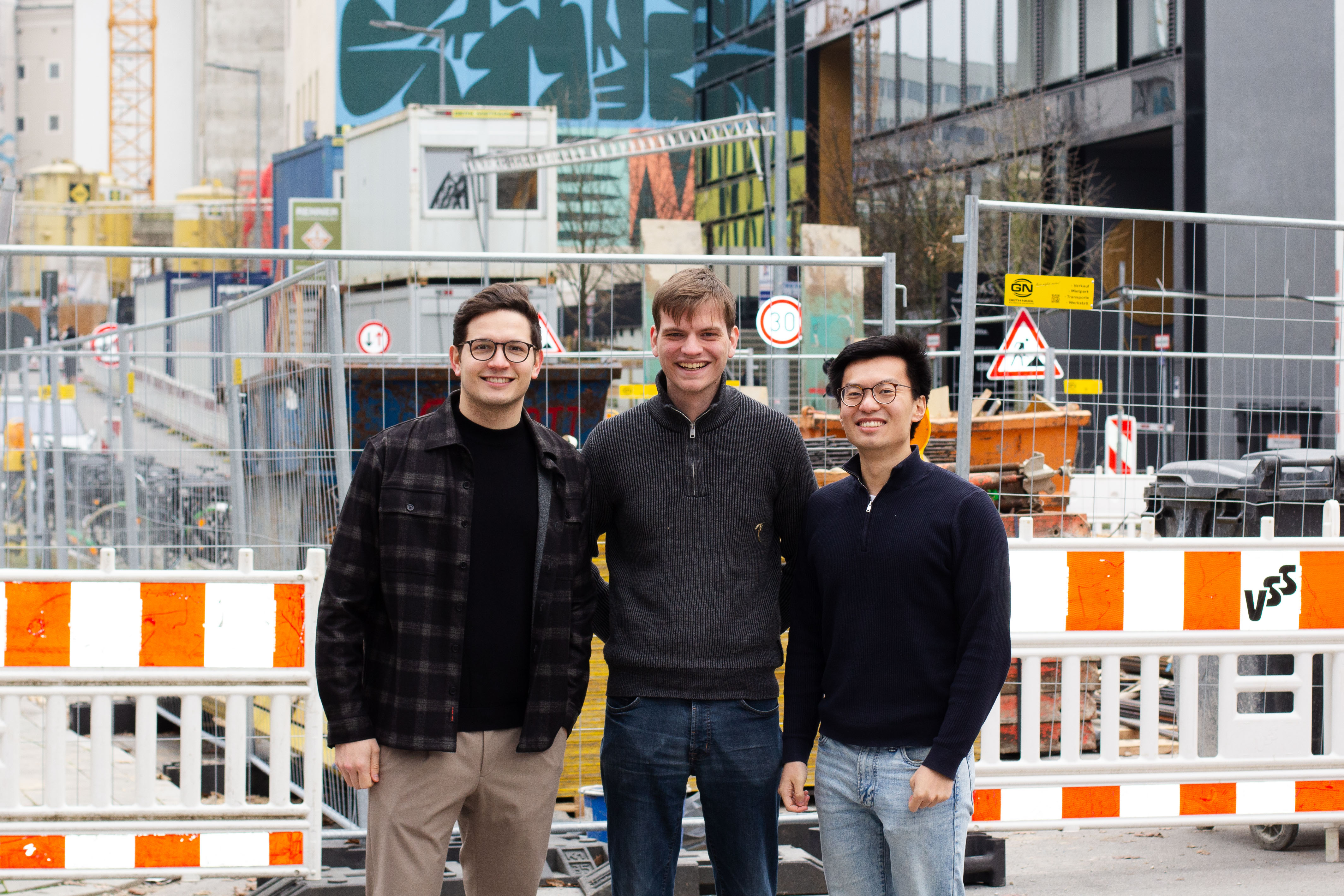
We are Lukas, Stefan & Sean, the co-founders of Mercura.
We share a deep commitment to excellence and the discipline to pursue what others might consider impossible.
Two of us come from non-academic families, and we all know what it means to create our own paths and overcome barriers. This experience shapes our belief in equal opportunity and fuels our dedication to social mobility.
Lukas (left) is responsible for business development at Mercura. With his background as a Data Scientist at Allianz and at Google in Silicon Valley, he brings extensive expertise in data and AI.
Lukas’ family has been active in the construction industry for over 100 years, giving him a deep understanding and passion for the sector's specific needs.
Sean (middle) is responsible for technical development at Mercura. As a top 0.01% physicist, Sean earned a Silver medal for Germany at the International Physics Olympiad (IPhO), began researching with the Max Planck Institute at the age of 16, and has since published at leading machine learning conferences.
Stefan (right) leads product development at Mercura. Previously, he worked in management consulting at Bain & Company, where he helped manufacturers improve their operations.
Stefan leverages his research experience at the Massachusetts Institute of Technology (MIT) and Harvard Business School to develop innovative solutions for the industry.
At Mercura, we believe that the best ideas emerge when people from different backgrounds collaborate together. We hire based on ability, mindset, and values, and we live by one simple rule: the best idea wins.
Beyond Mercura, we actively support initiatives that promote diversity and gender equity and commit a portion of our personal income each year to organizations expanding opportunity for others.
Our operating principles:
https://www.mercura.ai/careers



 Check My Fit

.jpg)